


And all I ask is a tall ship and a star to steer her by;
And the wheel’s kick and the wind’s song and the white sail’s
shaking,
And a grey mist on the sea’s face, and a grey dawn breaking.
I must down to the seas again, for the call of the running tide
Is a wild call and a clear call that may not be denied;
And all I ask is a windy day with the white clouds flying,
And the flung spray and the blown spume, and the sea-gulls
crying.
I must down to the seas again, to the vagrant gypsy life,
To the gull’s way and the whale’s way where the wind’s like a
whetted knife;
And all I ask is a merry yarn from a laughing fellow-rover,
And quiet sleep and a sweet dream when the long trick’s over.
VOCABULARY
|
WORDS |
MEANINGS |
|
WORDS |
MEANINGS |
|
lonely |
alone |
|
windy |
breezy |
|
steer |
guide/control |
|
flung |
move/toss |
|
mist |
fog/smog |
|
spray |
sprink |
|
dawn |
day break |
|
spume |
foam |
|
tide |
Alternate rising and falling of sea |
|
sea-gulls |
|
|
wild |
untamed |
|
vagrant |
tramp |
|
denied |
refuse to admit |
|
gypsy |
Free-spirited person/nomad |
|
gull’s way |
|
whale’s way |
way of the whales |
|
|
whetted |
sharpen |
|
merry |
cheerful |
|
yarn |
|
|
fellow-rover, |
|
|
quiet |
|
|
trick’s over |
|
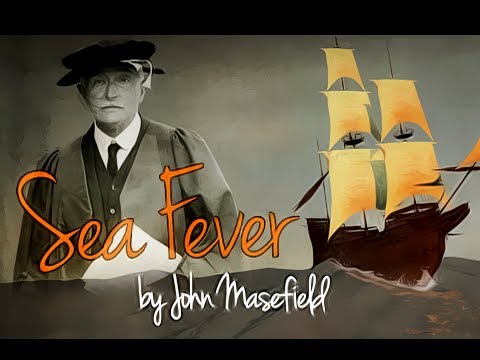
POET
He was an English poet
and writer, and Poet Laureate . Among his best known works are the children's
novels The Midnight Folk and The Box of Delights, and the poems The Everlasting
Mercy and "Sea-Fever".
SUBSTANCE
Masefield published "Sea Fever" in
1902.He did not use ‘go’ after ‘must’ in the first line of each stanza. Instead,
he used ‘down’ as a verb. But, he inserted ‘go’ at a later time, thereby changing
down to an adverb and altering the meter of the line. Some published editions
of his poems retain ‘go’.
This poem by John
Masefield is one of the famous poems
known for lust and love for nature. It was first published in 1902 in Salt-Water
Ballads. The poem speaks about a person who has a never-ending love
for the sea. He is desperate to go to the lonely sea. So, he is keen to have a ‘tall’
ship to sail through the sea. He asks the star to guide him throughout his
journey. On his adventure, he intends to enjoy the early mist that rises from
the sea along with grey dawn breaking. He wishes to witness the sight of strong
winds carrying the clouds and enjoys the cries of sea creatures.
The last stanza expresses the fact that the
poet just want to be like a wandering nomad. He would enjoy thrilling and
exciting tales from his fellow sailor and after the long journey he should have
a good sleep with a sweet dream.
TITLE
THEME:
In this poem the speaker
hears an irresistible call of the sea. It is an invitation for adventure and exploration.
It is lust for wandering about and to know the unknown. He wants to quit from his present and return
to the sea, the Nature. He is tired of rest. He is keen to have a life with
beauties of nature. A voyage can only give him life that is full of challenges.
In short, Masefield’s poem sums up the allure and excitement of voyaging or traveling .
CENTRAL IDEA
QUESTIONS: COLLECTED,
COMPILE & EDITED
1. What
is the Sea Fever poem about?
2.
What kind of poem is Sea Fever?
3.
What
message does the poet convey through the poem Sea Fever?
4.
Why
the poem is titled Sea Fever?
5.
Why
is word ‘grey’ repeated in the poem?
6.
What
do lines 7 through 11 reveal about the speaker in “Sea Fever”?
7.
Name
the creatures mentioned in the poem.
8.
What
sounds of the sea are recalled in John Masefield's "Sea Fever"?
9.
Why
does the poet describe the sea ‘lonely’?
10.
Why does the poet want to go to the sea again?
11.
Why
has the poet mentioned the wind as a "whetted knife"?
12.
What may not be denied by the poet?
13.
In
the poem "Sea Fever," why does the poet John Masefield ask for a tall
ship and a star to steer the way?
COMPLETE
THE SENTENCES
1.
I must go down to the _________________________________________
2.
I must go down to the _________________________________________
3.
I must go down to the _________________________________________
4.
The sea and sky will be _____________________________________
5.
And all I ask is ______________________________________________
6.
And all I ask is ______________________________________________
7.
And all I ask is ______________________________________________
8. The poet must go
down to the_______________________
9.
The ship that the poet
wants to travel on should be
10.
The poet needs a star to _____________________________
11.
By 'Wheel's kick' the poet wants to mean____________________
12.
The white sail is
shaking because_____________________________
13.
The colour of the dawn that breaks is_______________________
14.
The call of the running tide is_________________________________
15.
The poet cannot __________________________________________
16.
The day when the poet sets out on his voyage
should be ___________
17.
The poet longs for a ____________________________________
18.
In the poem 'Sea Fever', wind has been
compared to a _____________
19.
A 'yarn' is a tale of __________________________________________
20.
The poet wants a tale
to be told by ____________________________
21.
The poet wants to sleep ____________________________________





Post a Comment
0 Comments